
For permanent magnetic materials such as NdFeB, we mainly use its ability to generate and preserve magnetism, which is the most basic functional requirement for magnetic materials. So how to measure the ability of magnets to generate and preserve magnetism? We usually use four indicators: remanence Br, coercivity Hcb, intrinsic coercivity Hcj and maximum magnetic energy product BH (max).
To truly understand the above indicators, we must first understand the demagnetization curve. Because permanent magnetic materials need to be magnetized first, the magnetized permanent magnets need to withstand various factors that are unfavorable to magnetism during use. The demagnetization curve can effectively reflect the overall performance of the magnet.
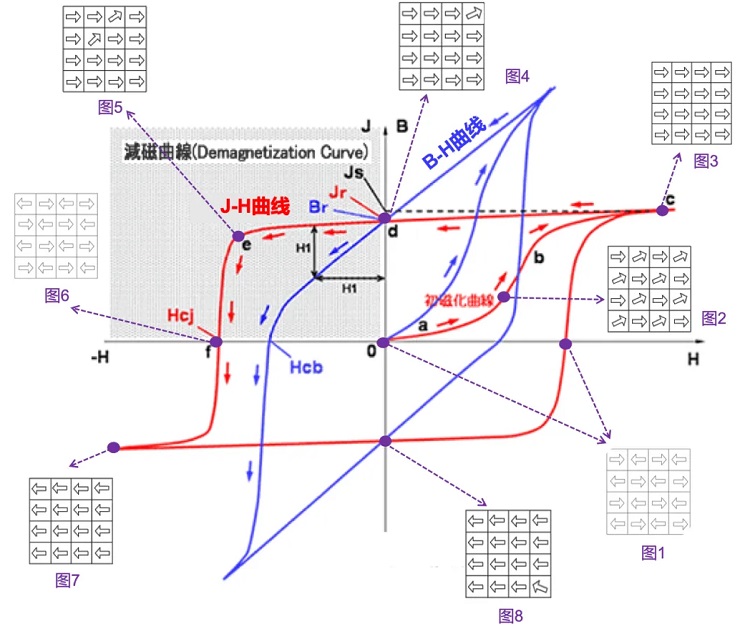
The above picture is a typical permanent magnet hysteresis loop. The first quadrant is the magnetization curve, the second quadrant is the demagnetization curve, the third quadrant is the reverse magnetization curve, and the fourth quadrant is the reverse demagnetization curve. The horizontal axis represents the external magnetic field intensity H, and the vertical axis represents the magnetic induction intensity B and the magnetic polarization intensity J. [Simply put, the magnetic induction intensity B is the accumulation of the external magnetic field and the internal magnetic field of the magnet, and the magnetic polarization intensity J is the internal magnetic field of the magnet]
The four magnetic performance parameters of remanence, coercive force, intrinsic coercive force and maximum magnetic energy product are all derived from the demagnetization curve. The red line in the above picture is called the J-H demagnetization curve (the curve of the change of magnetic polarization intensity J and the external magnetic field H), also called the intrinsic demagnetization curve, and the blue line is called the B-H demagnetization curve (the curve of the change of magnetic induction intensity B and the external magnetic field H). We use small boxes to represent magnetic domains. Magnetic domains can be understood as tiny magnets. A magnet is composed of a lot of magnetic domains. The arrow is the spontaneous magnetization direction C axis of the magnetic domain. For a permanent magnet in a magnetically neutral state (simply put, a magnet that has not been charged), most of the magnetic domains are in the same coordinates but their directions cancel each other out, so that no magnetism is shown to the outside, as shown in Figure 1.
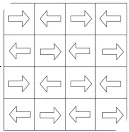 Figure 1.
When a magnetic field is applied along the magnetization direction, the magnetic domains gradually shift and rotate through the domain wall to make their C-axis directions consistent, as shown in Figure 2 . This is the magnetization curve. The magnetic polarization intensity value corresponding to the magnet at saturation magnetization is called the saturation magnetic polarization intensity Js.
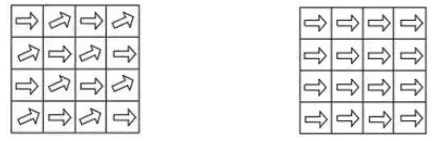 Figure 2
When the magnet is saturated and the external magnetic field is removed, it can be seen from the figure that most of the magnetic domains still maintain the same direction, and a small part rotates slightly but the main direction remains unchanged, as shown in Figure 3. In this way, the magnetic induction intensity and magnetic polarization intensity of the magnet both retain high values. This value is called the residual magnetic induction intensity Br or the residual magnetic polarization intensity Jr. The intuitive understanding is that when the external magnetic field is removed from the saturated magnet, the remaining magnetic induction intensity B or magnetic polarization intensity J of the magnet. When the external magnetic field H is 0, Br=Jr. We often use Br to describe it, which is what we most often call remanence, in units of Gs or T. The higher Br is, the stronger the magnetic induction intensity that can be retained, and the more potential it has to become a strong magnetic material.
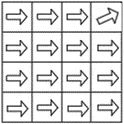 Figure 3
When the applied external magnetic field increases in the opposite direction, the magnetic domains of the magnet gradually shift and rotate, as shown in Figure 4. When the magnetic field strength reaches a certain value, the magnetic induction intensity B of the magnet drops to 0. Simply put, the magnetic field strength retained inside the magnet and the external reverse magnetic field strength cancel each other out. The corresponding magnetic field strength value at this time is called the magnetic coercivity Hcb (also written as bHc), with units of Oe or kA/m. The magnetic coercivity Hcb is closely related to the slope of the J-H demagnetization curve. If the magnetic domains of the magnet are unlikely to shift or rotate in a short period of time, the J-H line will be very straight, so that the value of Hcb will be infinitely close to Br, and the upper limit of Hcb is Br, Hcb=Br. This is an ideal situation, which means that there is no tendency for the magnetic domains to reverse before the reverse magnetic field strength reaches Br in value. In this way, the magnet is very stable, that is, the magnet has a very strong ability to resist demagnetization in the initial state of the reverse magnetic field value below Br.
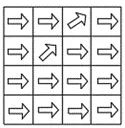 Figure 4
When the reverse magnetic field continues to increase and reaches a critical value, reverse magnetic domains appear quickly, causing the magnetic polarization intensity of the magnet to drop quickly to 0. In simple terms, the magnetic field intensity retained inside the magnet drops to 0, as shown in Figure 5. The corresponding magnetic field intensity value at this time is called the intrinsic coercive force Hcj (also written as jHc), with units of Oe or kA/m. The intrinsic coercive force is a physical quantity that reflects the magnitude of the magnet’s ability to resist demagnetization. The greater the intrinsic coercive force, the stronger the ability to resist demagnetization, or more precisely, the stronger the ability to resist complete demagnetization. Special attention should be paid to the difference between Hcj and Hcb. When Hcj is greater than Br, the limit value of Hcb is Br. When Hcj is less than Br, the limit value of Hcb is Hcj.
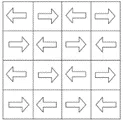 Figure 5
The product of B and H corresponding to any point on the B-H demagnetization curve is called the magnetic energy product. The maximum value is the maximum magnetic energy product (BH)max. Theoretically, the maximum magnetic energy product (BH)max=(½ Br)². The maximum magnetic energy product takes into account both remanence and magnetic coercivity. Its value represents the magnitude of the magnetic energy contained in the magnet and can also reflect the initial inclination of the J-H line. The unit is GOe or j/m³.
If the above four parameters are still difficult to understand, you can simply think that the magnet is a cup of water, magnetization is heating, remanence is the heat of the water after heating stops, demagnetization is like cooling the water, Hcb is when the ambient low temperature reaches a value, it offsets the heat of the water, and the overall heat is not reflected to the outside, and Hcj is the ambient low temperature value required to completely reduce the heat of the water to 0. The following is a simplified version of the second quadrant of the hysteresis loop, which can help you deepen your understanding of related concepts.
For the above magnetic parameters, we should pay attention to the following points in practical applications:
1. For magnets that require strong magnetic fields, we usually need to increase their remanence as much as possible to release more magnetism, but it should be noted that this is under the premise of no demagnetization. If demagnetization exists, simply increasing the remanence may be ineffective, and Hcj needs to be increased to reduce demagnetization. The simplest example is a D10*1 disc magnet. The surface magnetism of 54H is higher than that of N54. The reason is that the Hcj of 54H is higher, which allows its Br to be fully utilized, while the Hcj of N54 is very low and cannot maintain it in a non-demagnetized state. No matter how high the Br is, its magnetism cannot be fully utilized.
2. For magnets that require strong anti-demagnetization ability and stability, we usually need to increase Hcj, and the Hcb value needs to be as close to Br as possible.
3. For magnets that require good temperature resistance, we usually choose to increase Hcj, because the temperature coefficient of coercive force of NdFeB permanent magnets with the same Hcj is not much different. The most direct effect of increasing Hcj is to make the inflection point of the B-H line appear as late as possible or not appear at all. If strict requirements are placed on temperature stability, the requirements for Hcb must also be considered to minimize the slope of the B-H line to reduce the irreversible attenuation amplitude of the magnet.