
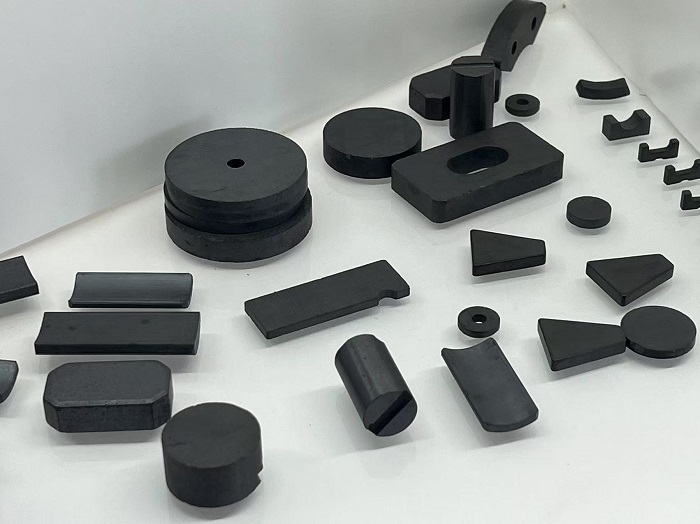
Ferrite magnets, also known as ceramic magnets, are made primarily from iron oxide (Fe₂O₃) and barium (Ba) or strontium (Sr) carbonate. The most common composition is barium ferrite (BaFe₁₂O₁₉) or strontium ferrite (SrFe₁₂O₁₉). These are types of ceramic compounds, where the iron oxide serves as the magnetic material and barium or strontium compounds provide the stabilizing structure.
The process to make ferrite magnets involves:
Mixing iron oxide with barium or strontium carbonate in a precise ratio.
Heating the mixture at high temperatures to create the ferrite compound (BaFe₁₂O₁₉ or SrFe₁₂O₁₉).
Milling the compound into a fine powder.
Pressing the powder into the desired shape, often in a mold.
Sintering (heating the pressed shape to a high temperature) to harden and form the magnet.
The end result is a hard, brittle material with good magnetic properties, which is widely used in motors, speakers, and various other electronic applications.
The main differences between barium ferrite (BaFe₁₂O₁₉) and strontium ferrite (SrFe₁₂O₁₉) lie in their magnetic performance and cost. Here’s a breakdown:
1. Magnetic Performance
Barium Ferrite (BaFe₁₂O₁₉):
Magnetic Properties: Generally, barium ferrite has a lower coercivity (resistance to demagnetization) and remanent magnetization (strength of the magnetic field it retains after magnetization) compared to strontium ferrite.
Energy Product: Barium ferrite magnets typically have a lower maximum energy product (BHmax), which means they are not as strong in terms of their overall magnetic performance.
Usage: Best suited for applications where moderate magnetic strength is sufficient, such as in lower-power motors, small speakers, and toys.
Strontium Ferrite (SrFe₁₂O₁₉):
Magnetic Properties: Strontium ferrite tends to have higher coercivity and remanent magnetization than barium ferrite, meaning it can hold a stronger magnetic field and is more resistant to demagnetization.
Energy Product: Strontium ferrite magnets generally exhibit a higher maximum energy product, making them stronger and more durable in terms of magnetic strength.
Usage: Preferred for applications requiring stronger magnetic fields, like in larger motors, magnetic separators, or high-performance speakers.
2. Cost
Barium Ferrite:
Cheaper: Barium ferrite magnets are generally less expensive than strontium ferrite. This is because barium is less expensive and more abundant than strontium.
Economical for Low-Performance Applications: Since they offer lower performance, they are a cost-effective solution for many consumer-grade products that don’t require the highest magnetic strength.
Strontium Ferrite:
More Expensive: Strontium ferrite magnets are typically more costly than barium ferrite. The primary reason is that strontium is more expensive to produce and has more desirable magnetic properties.
Higher Performance = Higher Cost: For applications that require more powerful magnets, the additional cost of strontium ferrite is justified.
3. Other Considerations
Corrosion Resistance: Both types of ferrite magnets are highly corrosion-resistant, unlike other magnetic materials like neodymium magnets. This makes them suitable for use in harsh environments.
Manufacturing: Both barium and strontium ferrite magnets are produced using similar manufacturing processes (high-temperature sintering), so the manufacturing complexity is quite similar. The difference in cost is more about the raw materials.
Summary:
Barium Ferrite (BaFe₁₂O₁₉) is cheaper but has lower magnetic strength, making it suitable for applications where cost is a concern, and the magnetic requirements are moderate.
Strontium Ferrite (SrFe₁₂O₁₉) offers higher magnetic performance and better coercivity, but it comes at a higher price, making it a good choice for applications where a stronger, more durable magnet is needed.
If you’re choosing based on performance and need a stronger magnet, strontium ferrite is the better option. If cost-efficiency is more important for lower-power applications, barium ferrite is the way to go.